Tipologia Servizio: Aesthetic orthodontics
Ceramic veneering
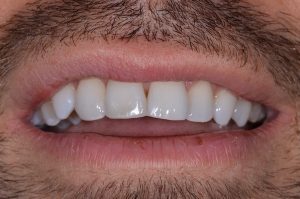
The veneers are thin restorations in translucent porcelain (0,3 – 0,5 mm thickness) which are cemented on the anterior surface of the teeth in order to improve the aesthetic aspect and to protect damaged teeth.
The result is really amazing: more than any other prosthetic restoration the veneers simulate the natural tooth and have an intense brightness which guarantees an incredible, natural smile
For this treatment it is necessary to make 2 or 3 appointments.
On the first appointment the teeth are prepared in a very conservative manner in order to create space for the veneers with an imprint at the end. The veneers are made by our specialists in a special laboratory.
On the second appointment are evaluate the shapes, the color and all the various adjustments. On the same appointment or on the following one the veneers are glued with fluorescent cements and with advanced adhesive techniques.
Thanks to the vitreous nature of the ceramic veneers the restorations do not change color in later years unlike those made in resin which are made of porous material and change color slightly with the passing of time.
The ceramic veneers are considered the best choice to improve your smile. They can be used to correct some areas such as:
- TEETH WITH STRANGE SHAPES
- ADULT DAMAGED TEETH
- BRUXISTS, BULIMICS, ATTACKS OF ACID SUBSTANCES
- TEETH COLOR AND SHAPE ALTERATIONS OF ENAMEL
- TEETH WITH SPACES BETWEEN THEM
- CHIPPED OR FRACTURED TEETH
- TEETH WITH POSITION ANOMALIES
- ROTATED OR UNALINED TEETH
Computerized evaluation of dental aesthetics
We analyze on a computer a series of images of your smile and then we evaluate all the possible solutions to improve it.
We are then able to transfer the image of your new smile from the computer to the image of your mouth using a few resin masks.
You will then personally verify the result of our simulation and eventually make some small changes..
You can bring the masks home so you can take your time and verify for yourself or consult another source.
All these simulations do not cause changes or problems for your teeth.
To perform the simulation of your new smile you need only two appointments:
First appointment.
- meeting with the patient and evaluation (together) of all aspects of the smile.
- Evaluation of color, shape and harmony. Imprints in the studio, x-ray, if necessary
- pictures of the face, profile and macro dental..
Second appointment:
- Evaluation of the smile and explanation of the techniques to improve it (DSD computer analysis.)
- Simulation with special resin veneering. Before making any changes to your teeth
Before making any changes to your teeth you can see what we can achieve with a very realistic simulation.


Total bleaching
Dental bleaching is a process that eliminates superficial spots of enamel (discoloration) increasing the brilliance of the tooth.
Usually teeth aren’t perfectly white as porcelain but they have small yellow shadows on the dental rim and gray-light blue transparencies on the incisal margins. Canine teeth are slightly more yellow on the rim. The color is not determined by the enamel which is translucent but by the dentine beneath it.
With the passing of time, teeth start to get darker and lose their brightness because secondary dentine is deposited.
There are three bleaching methods for dental polishing to eliminate superficial spots and re-establish the natural brightness of teeth. We deposit bicarbonate and polish different pastes on the teeth. :
- POLISHING : eliminates superficial spots and re-establishes the natural brightness of teeth. We deposit bicarbonate and polish different pastes on the teeth.
- BLEACHING: This method uses a very powerful oxidizing agent which brightens teeth (hydrogen peroxide or carbamide peroxide). The bleaching can also be performed in the dentistry office with more concentrated solutions using a special bleaching light or a laser. At home using special masks and less concentrated gels.
- MICROABRASION: This is a technique to eliminate color spotting (brown and white) of enamel on teeth which have not perfectly formed during growth.
Reconstruction with ceramic composites
The reconstruction with ceramic composites consists in the application of composite resins to the existing tooth, to perform fillings, to hide the discoloring of teeth, to fix broken crowns or to cosmetically improve the shape of some teeth. Generally the realization of a composite restoration requires only one appointment.
The plastic material is positioned on the tooth. it is modelled and polymerized with a special ultraviolet light that hardens the material. Later it is finished and polished in the same appointment.

Ceramic inlays
More and more patients wish to substitute their gray fillings in silver amalgam with restorations aesthetically perfect. Apart from the classical fillings in resin composite, there are ceramic restorations which are aesthetically much better and more resistant to abrasions and therefore more lasting in time.
Inlays are made with modern systems of CAD CAM which perfectly reconstruct the missing part of the tooth. Inlays will then be cemented to the tooth with composite cements.
With two appointments the tooth will be perfectly restored.
The main advantages of the ceramic inlays are:
- 1. Aesthetically superlative
- 2. Resistance to abrasions
- 3. Excellent biocompatibility
- 4. Hardness of a real tooth
- 5. Conservative technique
- 6. Avoidance of expensive crowns

