Tipologia Servizio: Dentistry Services
Ceramic veneering
The veneers are thin restorations in translucent porcelain (0,3 – 0,5 mm thickness) which are cemented on the anterior surface of the teeth in order to improve the aesthetic aspect and to protect damaged teeth.
The result is really amazing: more than any other prosthetic restoration the veneers simulate the natural tooth and have an intense brightness which guarantees an incredible, natural smile
For this treatment it is necessary to make 2 or 3 appointments.
On the first appointment the teeth are prepared in a very conservative manner in order to create space for the veneers with an imprint at the end. The veneers are made by our specialists in a special laboratory.
On the second appointment are evaluate the shapes, the color and all the various adjustments. On the same appointment or on the following one the veneers are glued with fluorescent cements and with advanced adhesive techniques.
Thanks to the vitreous nature of the ceramic veneers the restorations do not change color in later years unlike those made in resin which are made of porous material and change color slightly with the passing of time.
The ceramic veneers are considered the best choice to improve your smile. They can be used to correct some areas such as:
- TEETH WITH STRANGE SHAPES
- ADULT DAMAGED TEETH
- BRUXISTS, BULIMICS, ATTACKS OF ACID SUBSTANCES
- TEETH COLOR AND SHAPE ALTERATIONS OF ENAMEL
- TEETH WITH SPACES BETWEEN THEM
- CHIPPED OR FRACTURED TEETH
- TEETH WITH POSITION ANOMALIES
- ROTATED OR UNALINED TEETH
Computerized evaluation of dental aesthetics
We analyze on a computer a series of images of your smile and then we evaluate all the possible solutions to improve it.
We are then able to transfer the image of your new smile from the computer to the image of your mouth using a few resin masks.
You will then personally verify the result of our simulation and eventually make some small changes..
You can bring the masks home so you can take your time and verify for yourself or consult another source.
All these simulations do not cause changes or problems for your teeth.
To perform the simulation of your new smile you need only two appointments:
First appointment.
- meeting with the patient and evaluation (together) of all aspects of the smile.
- Evaluation of color, shape and harmony. Imprints in the studio, x-ray, if necessary
- pictures of the face, profile and macro dental..
Second appointment:
- Evaluation of the smile and explanation of the techniques to improve it (DSD computer analysis.)
- Simulation with special resin veneering. Before making any changes to your teeth
Before making any changes to your teeth you can see what we can achieve with a very realistic simulation.


Total bleaching
Dental bleaching is a process that eliminates superficial spots of enamel (discoloration) increasing the brilliance of the tooth.
Usually teeth aren’t perfectly white as porcelain but they have small yellow shadows on the dental rim and gray-light blue transparencies on the incisal margins. Canine teeth are slightly more yellow on the rim. The color is not determined by the enamel which is translucent but by the dentine beneath it.
With the passing of time, teeth start to get darker and lose their brightness because secondary dentine is deposited.
There are three bleaching methods for dental polishing to eliminate superficial spots and re-establish the natural brightness of teeth. We deposit bicarbonate and polish different pastes on the teeth. :
- POLISHING : eliminates superficial spots and re-establishes the natural brightness of teeth. We deposit bicarbonate and polish different pastes on the teeth.
- BLEACHING: This method uses a very powerful oxidizing agent which brightens teeth (hydrogen peroxide or carbamide peroxide). The bleaching can also be performed in the dentistry office with more concentrated solutions using a special bleaching light or a laser. At home using special masks and less concentrated gels.
- MICROABRASION: This is a technique to eliminate color spotting (brown and white) of enamel on teeth which have not perfectly formed during growth.
Reconstruction with ceramic composites
The reconstruction with ceramic composites consists in the application of composite resins to the existing tooth, to perform fillings, to hide the discoloring of teeth, to fix broken crowns or to cosmetically improve the shape of some teeth. Generally the realization of a composite restoration requires only one appointment.
The plastic material is positioned on the tooth. it is modelled and polymerized with a special ultraviolet light that hardens the material. Later it is finished and polished in the same appointment.


Prevention of oral cancer
Oral cancer represents 4% of all malignant tumors of mankind and 1% in women. If diagnosed on time, it is curable 90% of times. It is between 6 and 28 times higher than the risk of tumors in smokers if associated with alcohol.
The risk factors cigarette smoke, abuse of alcohol, trauma in the internal surface of the mouth. Other favorable causes are insufficient oral hygiene, incongruent and traumatic dental prosthesis. Usually affected are patients over 40 years of age.
In order to prevent oral cancer there must be a correct oral hygiene and a healthy life style.
These are the suggestions of the dentist:
- Eat a lot of fruit and vegetables
- Do not smoke
- Do not drink alcoholics or drink wine in between meals
- Do not associate alcoholics with smoke
- Keep a healthy and clean mouth. Old and incongruent prosthesis should be removed
- Examine the mouth every day, under and above the tongue, the cheeks, the palate, up to the uvula.
- If there are red or white spots (suspicious precancerous lesions, lichens, chronic wounds which tend not to heal, swollen gums) you must consult a specialist for a specific diagnosis. Do not hesitate to contact a doctor because a precocious diagnosis greatly influences the prognosis of these pathologies. A wound that does not heal, a white or red spot that doesn’t heal are possible bad signs.
- These wounds are not necessarily painful.
If in doubt talk to your dentist. He will examine your mouth and your tongue. If necessary he will perform a biopsy taking a small sample of tissue and he will then send it to be examined by a pathologist.(histological examination)
Ceramic inlays
More and more patients wish to substitute their gray fillings in silver amalgam with restorations aesthetically perfect. Apart from the classical fillings in resin composite, there are ceramic restorations which are aesthetically much better and more resistant to abrasions and therefore more lasting in time.
Inlays are made with modern systems of CAD CAM which perfectly reconstruct the missing part of the tooth. Inlays will then be cemented to the tooth with composite cements.
With two appointments the tooth will be perfectly restored.
The main advantages of the ceramic inlays are:
- 1. Aesthetically superlative
- 2. Resistance to abrasions
- 3. Excellent biocompatibility
- 4. Hardness of a real tooth
- 5. Conservative technique
- 6. Avoidance of expensive crowns


Gummy surgery with nd yang laser
Our office offers a laser technology of the latest generation NEODIMIO YANG AMERICAN DENTAL.
This technology has many applications in the surgical treatment of soft tissue and many advantages such as: Precision and safety when cutting, Vaporization of the inflammatory tissue eliminating bacteria, Crumbling of sub-gingival tartar and sterilization of pockets
.
In the surgical techniques of:
- GENGIVECTOMY
- GENGIVOPLASTY
- FRENULECTOMY
- PLASTIC SURGERY OF VESTIBOLO
- REMOVAL OF FIBROIDS AND HYPERPLASIAS
- CURING OF ABSCESSES WITH FISTULA
- ULCEROUS SORES
The post surgery recovery will be easier and better, with less swelling, less inflammation, less pain and a faster tissue regeneration.
Guided implantology
Dental implants are a valid option for the reactivation of one or more missing teeth. They are made in titanium and they are inserted in the jaw bone (maxillary or mandibular bone). After the bone has healed (bone integration) these will be used as artificial roots to support crowns, bridges or to retain dentures.
Modern studies have improved the shapes and the surfaces of implants to optimize their integration.
All our implants are certified and have undergone research so as to guarantee improvement in time.
There are various techniques for the use of implants:
- CLASSIC TECHNIQUE WITH SUBMERGED IMPLANTS: The implants are inserted and they are left to heal for 3 -4 months under the gums. A small incision will then follow to open the gums and connect the prosthetic components which will support the prosthetic tooth.
- POST EXTRACTION TECHNIQUE: The implant must be inserted in the dental alveolus after the extraction of the tooth in the residual bone.
- IMMEDIATE LOADING : In particular situations of implant insertion with a primary good stability as soon as they are inserted. The implant will be loaded immediately with a crown and it will function right away. This technique is used in situations of top quality aesthetics or in rehabilitations with more than one implant joined together.
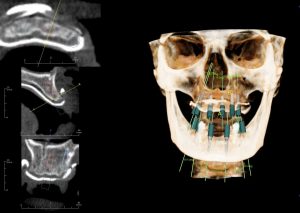
- IMPLANT SURGERY GUIDED BY SURGICAL DIME: Having acquired, for our offices, a new tri-dimensional system (volumetric TAC) and a very advanced elaboration program called ANATOMAGE, we are able to provide an innovative Implant Surgical plan. With this program it is possible to analyze the type and thickness of the bone in three dimension (its volume) and the remaining bone anatomies with millimeter precision.
We can then simulate the operation and the correct positioning of the implants, taking into account , the direction of insertion, the inclination and the size of the implant, all on the computer.
A very precise operative diagnosis that enables the operator to reduce, to the maximum, all operational risks.
We have every kind of information regarding the surgery we have to perform . In addition to a correct planning, we also have the possibility of achieving a precision DIME that will carefully guide the insertion of the implant in the oral cavity. A new way of approaching implants that enables us to achieve even the most difficult cases in total safety.

Therapies for gum diseases
The health of your mouth , teeth and gums has a direct impact on your overall health. Research has demonstrated that the same bacteria which causes gum inflammation can expand and create problems in other parts of our body: the heart (both coronary and valves)
Other affinities can be connected to DIABETES, PREGNANCY PROBLEMS, HEART ATTACKS and an increase of the tumor of the pancreas.
The gum treatment consists of the elimination of bacteria on the gums.
The surgery consists of performing an open flap surgery to reduce the jaw pocket already existing. All the tartar will be removed from the gums. The removal of this tartar will enable the gums to heal.
The candidates for the gum therapy are all patients with inflamed, swollen, flushed and bleeding gums or with bad breath.